

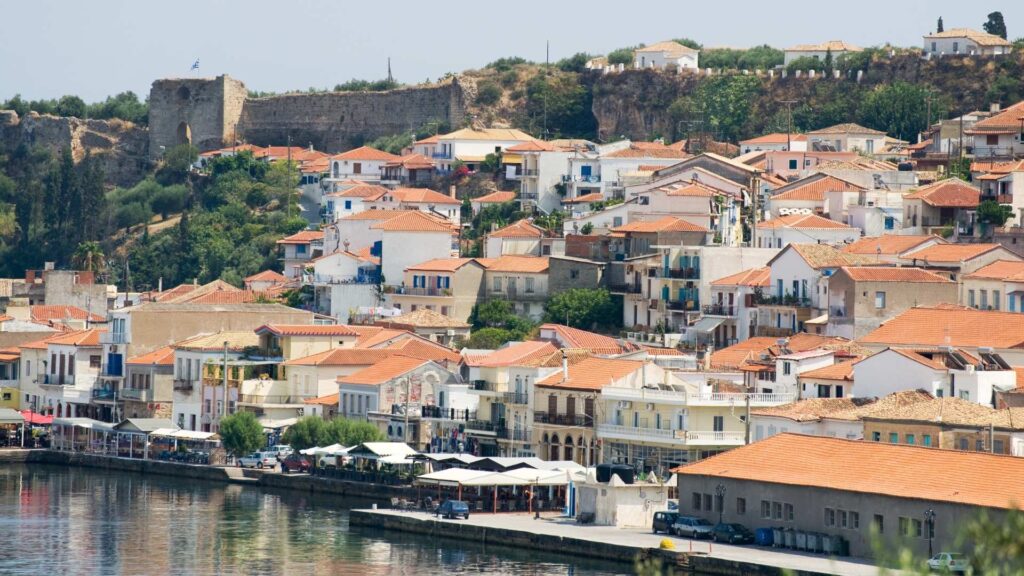
Most castles in Greece are archaeological sites. Koroni is a neighborhood.
You walk up through the settlement, pass through the gate, and find yourself still on a street—with houses, gardens, cats on garden walls, laundry hanging between olive trees, and an active monastery where the fortress courtyard once stood. The castle was never abandoned; people simply kept living inside it.
This is precisely what sets Koroni apart from every other fortress in Messinia, and why it rewards a leisurely half-day visit rather than a quick stop.
The Other Eye of Venice
Koroni and Methoni were known as the “Eyes of the Serenissima”—the twin Venetian ports that kept watch over the maritime route between Venice and the East. Venice held Koroni from the early 13th century until 1500, when it passed to the Ottomans; the two powers subsequently exchanged control of the site over the following centuries.
Because the castle remained inhabited, its layers are superimposed rather than distinct: Venetian walls, Ottoman additions, Byzantine churches, and a more recently founded monastery all lie within the same enclosure.
What to See
The gate and the walls. The entrance is located at the upper part of the settlement, reached via an easy uphill walk past whitewashed houses and bougainvillea. Inside, the paths are open, allowing you to wander freely.
The Monastery of Timios Prodromos (St. John the Baptist). An active convent occupies a large part of the interior, surrounded by gardens that rank among the most serene spots in Messenia. Modest attire and a quiet voice are required—people live and pray here.
The Church of Agia Sophia. Byzantine remains within the walls; small and easily overlooked if you aren’t looking for them.
The view of the Messenian Gulf. From the sea walls, you look east toward Mani and Mount Taygetos rising behind it. On a clear September afternoon, the mountains are so distinct that you can count the ridgelines.
The settlement below. Narrow alleys, waterfront cafés, fishing boats, and a staircase that is hard to miss.
Zaga Beach
Located beneath the castle on the southern side, Zaga is one of the largest sandy beaches in this part of Messinia—a wide, shallow, and spacious stretch of coast offering both organized and quiet sections, depending on how far you walk.
It is the natural second half of a day in Koroni: the castle in the morning while the light is good and the air is cool, and the sea in the afternoon.
If you are comparing swimming options in the area, our guide to the beaches around Gialova covers the northern side.
Getting There from Gialova
Koroni lies on the opposite side of the peninsula from Gialova—facing the Messenian Gulf rather than the Ionian Sea—so the drive is longer than the trip to Methoni or Pylos.
Two routes:
The coastal route — heading south via Pylos and Methoni, then east along the coast through Finikounta. It is slower but undeniably more scenic, allowing you to combine multiple stops into a single loop.
The inland route — heading northeast to Rizomylos and then south along the gulf via Petalidi. It is faster and more straightforward, with the Messenian Gulf on your right for the final stretch.
Time: allow about an hour to an hour and a half each way, depending on the route and stops.
A candid note on transport: this is a drive best suited for a car or a large motorcycle. A 50cc scooter will get you there, but it isn’t recommended. If you want that same coastal road experience on two wheels, the route to Methoni is the right choice—half the distance, same road character. Scooters, e-bikes, and bicycles are available at Martin’s Rentals.
Planning Your Day
| Time | Where | What |
|---|---|---|
| Morning | Gialova → Koroni | Coastal or inland route |
| Late morning | Castle & monastery | Walls, gardens, view of the bay |
| Midday | Settlement | Lunch at the harbor |
| Afternoon | Zaga Beach | Swimming and shade |
| Late afternoon | Return | Coastal route to catch the light |
Practical Notes
- The walk up is uphill, involving stone paths and steps. Comfortable shoes make a real difference.
- The monastery is an active religious community. Shoulders and knees must be covered; please keep voices low.
- Parking is easier lower down, near the harbor; the upper streets are narrow.
- September is arguably the best month to visit—the sea retains its warmth, the village feels less crowded, and the light over the bay is at its clearest.
Frequently Asked Questions
How far is Koroni from Gialova?
About an hour to an hour and a half by car, depending on whether you choose the coastal or the inland route.
Is entry to the castle free?
The interior of the fortress is an open, inhabited area rather than a fenced archaeological site requiring an admission ticket—you simply pass through the settlement’s gate.
Is Koroni worth a full day?
Yes. The castle, the monastery gardens, the old settlement, and Zaga Beach easily fill a whole day.
Which beach should I choose in Koroni?
Zaga, on the southern side below the castle—it is long, sandy, and shallow.
Can Koroni be combined with Methoni?
Yes, via the coastal route through Finikounta. Allow a full day for both.
Before You Start
The Martin’s in Gialova is on your way out of the village, and the store operates 24 hours a day during the summer months.
More ideas: activities in Gialova.