

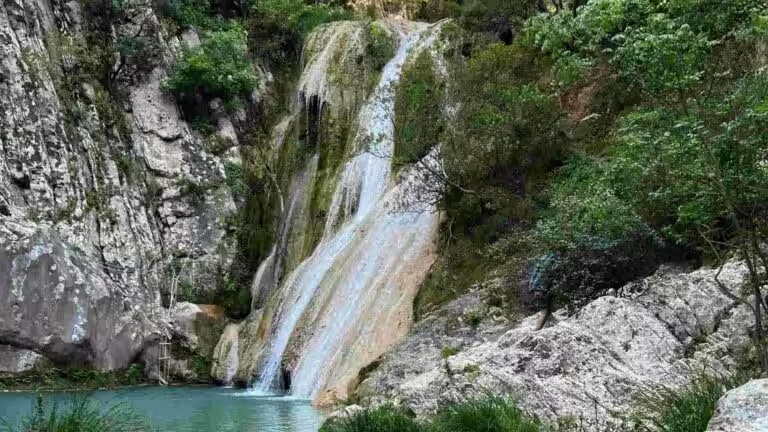
You come to this area for the inland gorge, home to a cluster of small green pools and a waterfall cascading into the deepest among them—and the entire atmosphere of the region shifts.
Polylimnio—the name describes exactly what it is—is a narrow, shaded ravine near the village of Charavgi, less than an hour from Gialova. A stream runs through it, punctuated along its course by small pools linked by waterfalls, each with its own name and unique shade of green.
It makes for the perfect half-day excursion away from the beach in Messinia, and it is at its best precisely during the months when the pace of everything else slows down.
What You’ll Actually Find There
The ravine is narrow and thickly shaded by plane trees—the temperature drops noticeably the moment you step inside. The path follows the water, crossing it via small wooden bridges and climbing over rocky sections at times, with the pools appearing one after another.
The pools have names—Kadi, Italou, Mavrolimna, and Kondolimna among them—and the route is essentially a sequence: pool, short climb, then another pool.
**Kadi Waterfall** is the destination. It features a high drop of water plunging into a deep, cold, dark-green pool at the bottom of the gorge, surrounded by sheer rock faces. It is the spot everyone photographs and where most people simply sit for a while.
The Route
**Starting point:** The parking area at the entrance, near Charavgi. **Type:** A streamside path featuring small wooden bridges, steps, and some light rock scrambling in the upper section. Time: about 1.5 hours for the lower pools; 2.5–3 hours to reach the Kadis waterfall and return at a leisurely pace. Difficulty: easy at the start, moderate higher up. The final section features uneven rocky terrain and, depending on the season, wet surfaces.
You don’t need hiking experience. You do need shoes with good grip and a willingness to get your feet wet.
If you enjoy this type of walk, the hike from Voidokilia to Paleokastro is the coastal equivalent—open and dry, with the sea below you instead of water right beside you.
When to Go
Water levels determine everything at Polylimnio. The waterfalls flow most vigorously from late autumn through spring, when the stream is fed by rainfall. By late summer, the flow is at its lowest and some smaller waterfalls dwindle—the pools remain, but the intensity drops.
The gorge comes back to life from September onwards. After the first autumn rains, the water flow strengthens again; the summer crowds have departed, and the shade—refreshing in August—becomes perfect in October.
Early morning offers the best light filtering through the trees and the quietest trails. At midday during peak season, the lower pools get crowded.
After heavy rain, wait. A gorge with a running stream reacts quickly to rainfall, and the combination of slippery rock and rising water is something to avoid. Give it a day.
Safety — Read This Section
Polylimnio is stunning, but it is not a swimming pool. A few things matter:
- The rock is slippery wherever water touches it.
- The water is cold and deep in the main pools—much colder than the sea. Enter gradually.
- Diving from the rocks is a bad idea. Depths vary, the bottom isn’t visible, and submerged rocks shift with the seasons.
- Mobile signal is unreliable inside the gorge.
- Go with company. It’s not a place for walking alone if you aren’t sure of your footing.
None of this makes it dangerous. It simply makes it a place that rewards the same respect you would show any mountain stream.
What to Bring
- Secure footwear — sneakers or hiking sandals. Flip-flops make the upper trail a hassle.
- Towel and swimsuit, if you plan to get in the water.
- Water and a snack. Facilities at the entrance are limited and seasonal.
- Waterproof case or a simple plastic bag for your mobile phone and camera.
- Lightweight clothing. The gorge is genuinely cooler than the coast.
You can find all of the above at Martin’s in Gialova, which is open 24 hours a day—handy if you decide to go in the evening and set off at seven.
Getting There from Gialova
Polylimnio is located inland, northeast of Pylos, near the village of Haravgi; there is signage from the Pylos–Kalamata road.
Time: about 35 minutes by car. Road: paved all the way to the parking area; the final stretch is a narrow country road. Parking: designated area at the trailhead.
Transport: this excursion requires a car. The distance and the final stretch aren’t suitable for a 50cc scooter, and you’ll want dry clothes waiting for you. For short coastal trips—to Pylos, Methoni, or the lagoon—Martin’s Rentals offers scooters, e-bikes, and bicycles.
Check out all the excursions from Gialova to see how this fits in with the rest.
Frequently Asked Questions
How long does the hike at Polylimnio take?
About 1.5 hours for the lower lakes and 2.5–3 hours for the Kadi waterfall (round trip).
Can you swim at Polylimnio?
Yes, in the lakes. The water is cold and deep in places—enter gradually and avoid diving from the rocks.
Is there an entrance fee?
Access is free via the parking area at Haravgi.
Is it suitable for children?
The lower section is, provided there is supervision. The hike up to Kadi is better suited for older children.
What is the best time to visit?
From autumn to spring, when the water flows more strongly. The flow is at its lowest in late summer.