

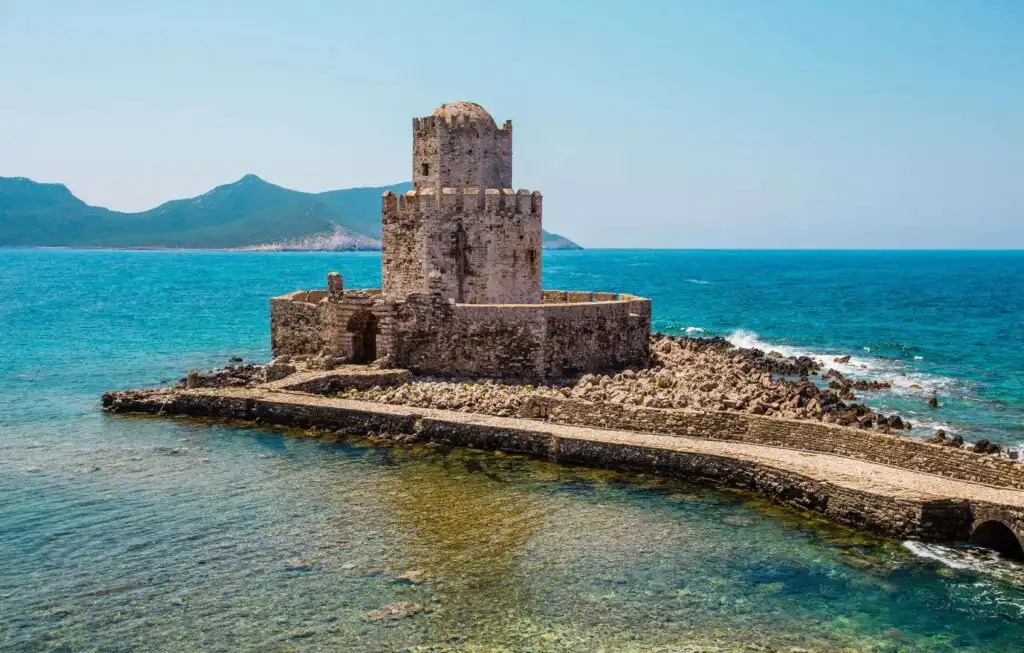
Methoni Castle occupies the entire rocky peninsula at the southwestern tip of Messenia; it is surrounded by water on three sides and accessible via a single stone bridge. It is one of the largest and best-preserved fortification complexes in Greece and is located just half an hour from Gialova.
This guide covers everything practical you need to know: how to get there, what to look out for inside, how much time to allow, and how to plan a full day around your visit.
Why It’s Worth the Trip
For three centuries, Methoni was one of the two “Eyes of the Most Serene” (La Serenissima)—the pair of Venetian ports (along with Koroni) that controlled the maritime route from Venice to the East. Every galley heading east would dock here. Every pilgrim bound for the Holy Land passed through this port.
The Venetians took the site in 1209 and held it until 1500, when it fell to the Ottomans after a long siege. Both eras are still visible in the stonework: Venetian walls and bastions, an Ottoman bathhouse, and a small, solitary octagonal tower standing in the sea.
What makes it unusual is its scale. It is a fortified city, not merely a tower; within the walls, there was once an entire settlement, complete with streets, churches, and cisterns. You are walking through the remains of a place where people lived, not just a defensive outpost.
Getting There from Yalova
Distance: approximately 8 km south, via Pylos. Time: around 10 minutes. Road: An asphalt provincial road the entire way, with the sea on your right for a large part of the journey.
The route is straightforward: head south from Gialova towards Pylos along Navarino Bay, pass through the town, and then take the road to Methoni. It is one of the easiest routes in Messinia—no mountain passes, no dirt roads.
By scooter or e-bike. The most enjoyable way, and the reason many visitors choose it for their first outing: the road is quiet, the surface is good, and you can stop wherever the view catches your eye. Scooters, e-bikes, and bicycles are available at Martin’s Rentals in Gialova.
By car. Just as simple. There is parking near the castle entrance, and finding a spot is rarely difficult, except during the peak weeks of August.
How to combine it. You can combine a visit to Methoni with other excursions—check out all the excursions from Gialova.
What You Will See Inside
The bridge and the main gate. The approach leads across a stone bridge spanning the moat that separates the fortress from the mainland. The gate beyond it is the original Venetian entrance, and its scale sets the tone for everything that follows.
The walls and bastions. You can walk along extensive sections of the fortifications. On the seaward sides, the drop to the water is sheer, and the view opens up westward toward Sapientza.
The Ottoman bathhouse. A small, domed hammam survives within the walls—one of the clearest traces of the Ottoman period.
The remains of the Venetian church. Amidst the ruins stand parts of the settlement’s religious structures, alongside granite columns from earlier constructions.
The Bourtzi. The octagonal tower situated on its own islet at the southern end, connected to the castle by a narrow strip of land. Built by the Ottomans after 1500, it is the image of Methoni that almost everyone remembers—a tower standing in open water, with nothing else around it.
Allow 1.5 to 2 hours to explore it properly. The site is vast, and there is much more to see inside than is visible from the road.
The Best Time of Day
Early morning offers a nearly empty site and light streaming in from the east, across the water.
Late afternoon is the photographer’s window: the walls take on a honey-hued glow, and the Bourtzi tower stands in striking contrast against the sunset.
Midday in summer requires planning—shade is scarce, and the stone retains the heat. While this is less of an issue in September than in July, bringing water and a hat remains a wise choice.
The Nearby Beach
Methoni’s beach begins right next to the fortress: it is long and sandy, with shallow waters extending quite a distance out, and is far calmer than the open beaches further north. It offers a completely different swimming experience compared to Voidokilia—less dramatic, more relaxed, and perfect after a two-hour walk across sun-baked stone.
Bring a swimsuit. Anyone who arrives without one regrets it by midday.
Where to Eat
The village behind the castle features tavernas just a few minutes’ walk from the entrance, many with tables facing the fortress walls. Fish is the obvious choice; ask what arrived fresh that morning instead of reading the menu from start to finish.
If you are spending the whole day in the area, the guide on where to eat in Pylos covers the harbor for your return.
Practical Tips
- Shade is limited. Bring a hat, water, and sunglasses—especially between 12:00 and 16:00.
- Footwear matters. The terrain inside consists of uneven stone and gravel. Sandals are fine; flip-flops are not.
- The causeway to Bourtzi gets splashed with water when it’s windy. Check conditions before crossing with your camera in hand.
- Catch the light on the way back. If you leave Methoni in the late afternoon, the Messenian hills and their sunset glow will accompany you all the way to Gialova.
Frequently Asked Questions
How far is Methoni from Gialova?
About 8 km—roughly a 10-minute drive via Pylos.
How much time do I need at the castle?
1.5–2 hours for the main site; 3–4 hours if you include a swim and a meal in the village.
Can I go by scooter?
Yes—it is one of the most popular routes from Gialova, and the road is paved the entire way.
Is there a beach in Methoni?
Yes, right next to the fortress: sandy, shallow, and calm.
Is it suitable for children?
Yes, provided you exercise the usual caution near the unprotected edges of the walls.
Scooters, e-bikes, and bicycles at Martin’s Rentals, Gialova.
Ask us for details about the route—we ride it ourselves.
More ideas for the day: activities in Gialova.