

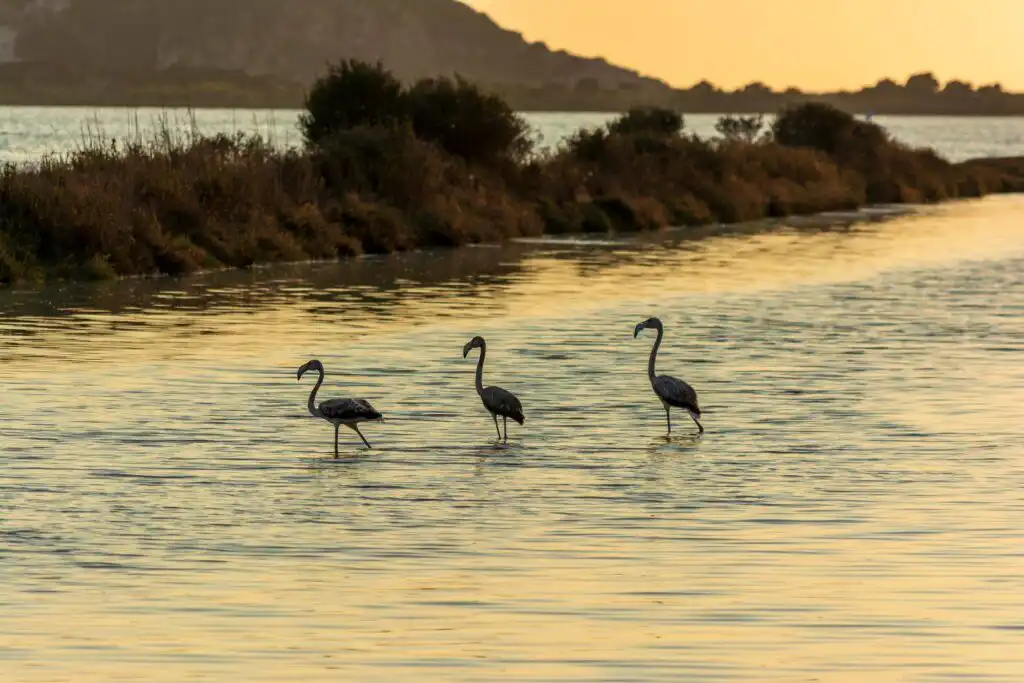
Most people come to Gialova for the beach. But the lagoon behind it might be the more extraordinary place.
The Gialova Lagoon is one of the most significant wetland ecosystems in southern Europe — a Natura 2000 protected area that sits between the village and Voidokilia beach, quietly hosting one of the continent’s most impressive concentrations of wildlife.
Here’s what makes it special, and how to see the best of it.
What Makes the Lagoon Remarkable
The numbers alone: over 270 bird species have been recorded here, including flamingos, herons, cormorants, egrets, and dozens of migratory species passing between Africa and Europe each season.
But the headline fact is this: the Gialova Lagoon is home to the only wild population of the African chameleon (Chamaeleo africanus) in Europe. These reptiles — genuinely rare anywhere outside of Africa — have established a small colony here, and can occasionally be spotted in the vegetation around the lagoon’s edge.
You can spot them at night with flashlights, as they glow while they sleep in the branches of the bushes. Be careful not to touch them or take them with you. It is expressly forbidden, it is a protected species, necessary in the animal kingdom.
Divari Beach (Chrysi Akti)
Running along the seaward edge of the lagoon is Divari beach — known locally as Chrysi Akti, the Golden Coast.
It’s a long, wide sandy beach with very calm, shallow water. Less dramatic than Voidokilia, but beautiful in its own quiet way. Sunbeds and beach bars in high season. In spring and autumn, it’s often almost empty.
The light here in the late afternoon is extraordinary — the lagoon behind you picking up the golden hour, the Ionian ahead turning deep blue. One of the best spots in Messinia for sunset.
The Cycling Route Through the Lagoon
The most rewarding way to experience the lagoon is by bike. A flat, quiet path runs from Gialova village through the lagoon area, past the edge of Divari beach, and continues north toward Voidokilia.
The whole route is around 5–6 km each way, largely flat, and passes through landscapes you won’t see from a car.
Rent a bike or e-bike at Martin’s Rentals in Gialova — it’s the perfect morning ride. Allow 2–3 hours to do it properly, stop for a swim at Voidokilia, and come back via the same route or via Petrochori.
Birdwatching Tips
The best seasons are spring (March–May) and autumn (September–November), when migratory birds stop over on their routes. Flamingos are present most of the year.
The best time of day is early morning — before the wind picks up and before other visitors arrive. Binoculars help, but the flamingos in particular are visible from the path even without them.
There’s no entrance fee or formal visitor centre at the lagoon — just approach quietly, stay on the path, and don’t disturb the vegetation near the water’s edge.
Getting There
The lagoon is immediately accessible from Gialova village — on foot, by bike, or by scooter. The cycling/walking path starts near the south end of the village and follows the edge of the wetland.
Martin’s Rentals in Gialova has bikes and e-bikes available daily. The lagoon route is their most popular recommendation.